• Blog
  • About
  • Tutorials
  • Prolost Store
  • Archive
    • Recent
    • Featured
    • All
  • Where to Begin?
  • Maschwikipedia
  • Contact
  • Comment Policy
  • Menu

Prolost

by Stu Maschwitz
  • Blog
  • About
  • Tutorials
  • Prolost Store
  • Archive
    • Recent
    • Featured
    • All
  • Where to Begin?
  • Maschwikipedia
  • Contact
  • Comment Policy
No results found

The Subway Short is the new Resolution Chart

November 21, 2008

Folks following me on Twitter and watching the comments here have noticed that I’m a bit obsessed with an offhanded comment made on the Rebel Café. In response to some technically sound but rather dry sample footage from the Ikonoskop A-cam dII, Gage replied:

I need to see a subway short.

After I cleaned the coffee off my keyboard, I contemplated the profundity of that statement. See, it wasn’t long ago that when a new camera showed up, we wanted to see test shots of Macbeth swatches and resolution charts. Or at least we thought we did. But lately, some crazy filmmakers have brought art to a technology fight, and they are kicking ass. There’s the D90 Subway test, and one shot with the RED One as well. And there’s Reverie, AKA The Bourne Zoolander (you know I love you Vincent). These aren’t really short films, they’re emotional trigger experiments. They’re camera tests designed to tickle our cinema bone rather than satisfy our slide-rules. They promise a cinematic feel rather than razor sharp 4K filmouts. We watch them on our computer screens and on our TVs. You know, where we watch everything.

For every piece of footage that seemingly proves that the Nikon D90 D-Movies are unusable, there’s at least one that shows how great the footage can look if you work within the camera’s limitations. Ditto the 5D MkII. Folks seem less interested in how a camera fares on a test bench than how it handles being serupticioulsy weidled in a no-photography zone. After Gage’s comment, the Ikonoskop guys actually posted a tiny clip that’s kinda like a subway short!

I told Gage I’d make t-shirts, and I did (all credit goes here). Proceeds go toward buying Gage a beer.

A month ago I wrote that “buttons and features and resolution charts just had their ass handed to them by sex apeal,” and now that movement has a mantra. So when a camera company comes at you with specs and megapixels and data rates, you know what to tell them.

I need to see a subway short.

Tags: Cameras, Filmmaking, RED
19 Comments

On the other hand...

November 21, 2008

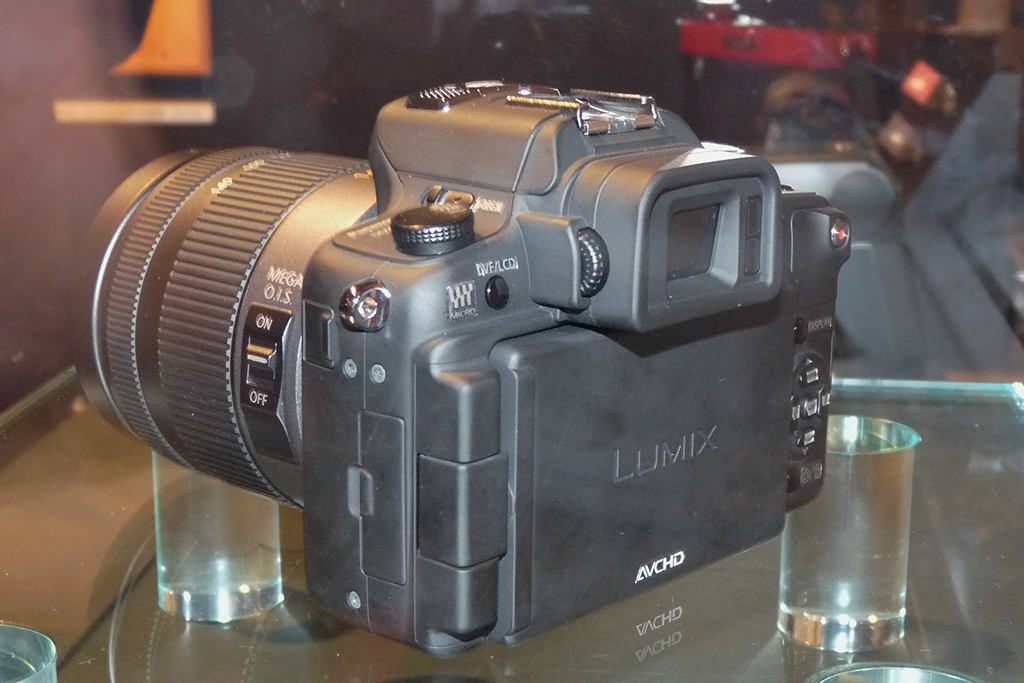
...by the time the Scarlet Bolex might become available, we might also have the above camera. Micro 4/3 format, interchangeable lenses and autofocus (probably), HD video and 12 megapixel stills (most likely), all for somewhere in the neighborhood of $1,000 (pure conjecture, although the G1 is currently only $800 with a lens).

You'll have to weigh 3K raw vs. whatever compressed video format Panasonic chooses for the Lumix G (we usin' code names) of course. And there's always the chance that Panasonic will do something stupid to limit the G's professional use, like skipping 24p or hampering manual control. But more than any other camera company, Panasonic has shown the ability to overcome engineering inertia and do the important next thing. We have them to thank for consumer 24p—which we take for granted now, but was a monumental event that Canon and Sony were slow and reluctant to follow.

I for one can't wait to see the subway shorts.

Oh yeah, and:

UPDATE: Looks like the prototype LUMIX G has an AVHD badge on the back (thanks to dcloud for the link in the comments). That's good news, it's a post-friendly codec supported by many NLEs.

Tags: Cameras, RED
27 Comments

I may complain a lot...

November 21, 2008

…but this little guy looks pretty sweet.


This appears to be the fixed-lens Scarlet design. In this configuration it’s like a digital Bolex H16.

Remember that films shot on 16mm have won Academy Awards, and that 2/3” HD video cameras currently cost $14,000 and up.

Tags: Cameras, RED, Scarlet
13 Comments

So Jim Called...

November 17, 2008

As the comment count approached 100 on my last post, Jim Jannard sent me a note asking if he could explain some of the less obvious aspects of the new RED product line. It turns out that Jim has a complex, nuanced vision for how people will use these cameras, and he was eager to explain it to someone who might grok it.

Without trying to speak for Jim, his basic message was that he is indeed making the camera I'm asking for—just not at the price I was hoping for.

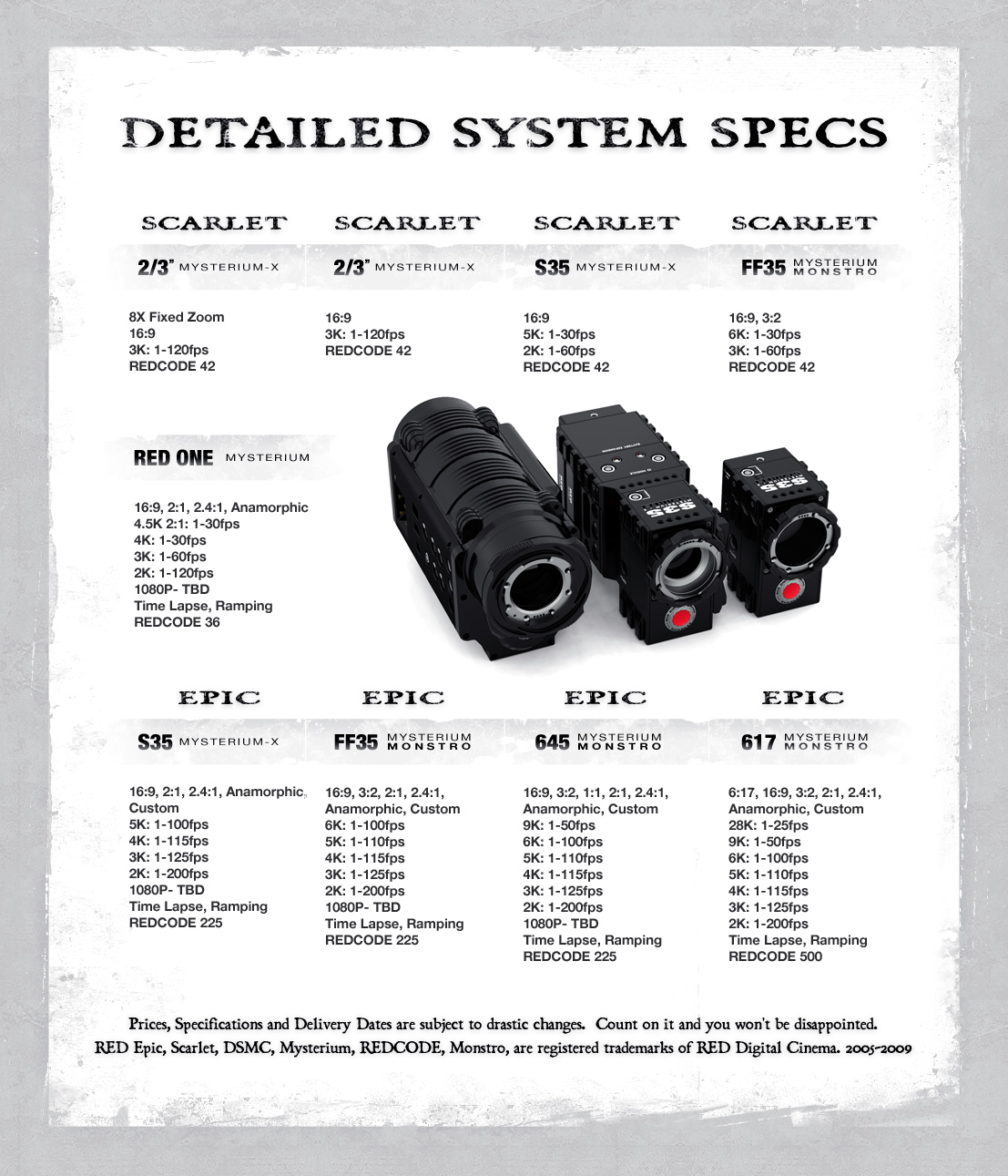
The secret lies in the format chart that he posted late last week, the one that details the various windowing options for the various brains. Jim's vision is that these windowing options represent not just a way for us to compromise field of view for frames-per-second, but in fact a way for filmmakers to design their own formats, project by project.

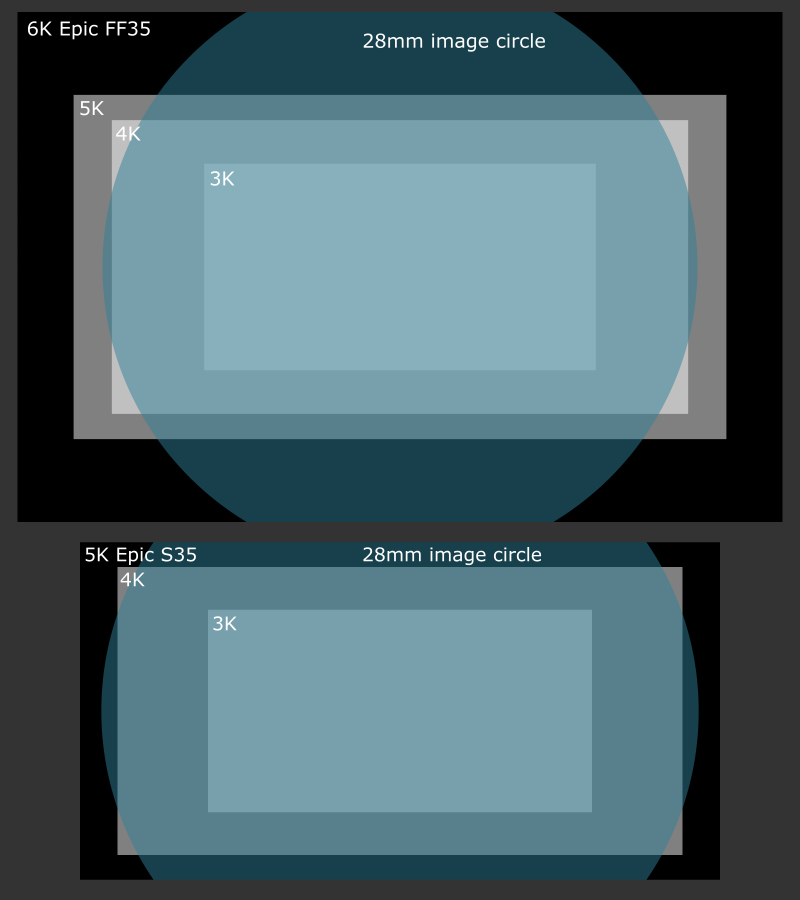
For example, on the Epic S35, one could design a project around PL-mount lenses that might porthole noticeably at the full 5K width, which is wider than Super 35. But window in to 4K and you're basically shooting with the RED One, except you've got better dynamic range and up to 115 fps.

On the Epic FF35, you could define exactly the 4K window with your vast sensor that would capture an Academy-sized image and shoot with anamorphic lenses. This would be different than the 4K window you'd shoot to for a 2:35 center crop with spherical PL-mount lenses. And the next day you could be shooting 6K using every millimeter of your Canon L-series.

When you look at it this way, Jim's building blocks offer a dizzying number of options, more even than was clear at first glance. It's a ton of rope, well more than enough to hang oneself (the post options just got officially redonkulous), but also pretty freaking cool. Owner-operators will be able to dial in custom crops that make the most of their glass, and play with the relationship between over-the-top resolution, FOV, and slow-mo capability. Jim called it "elbow room"—the excessive resolutions and slightly-bigger-than-standard gates are designed not to become new standards as much as to encompass a perpetual choice of existing ones.

This diagram is mine, not RED's, and is just guesswork and supposition and therefore probably completely wrong. Stop looking at it already!

Jim's perspective was that he had indeed offered the camera I want. The Epic S35, windowed to 4K, is a cinema-sized sensor that takes cinema and DLSR lenses and offers frame rates up to 115 fps.

It's also $28,000 without ports, batteries, or recording media.

To my way of thinking, the camera features most important to a filmmaker are sensor size, dynamic range, and maximum frame rate. Images should look good projected in a theater and on HD—anything more gets into specialty territory.

To me, the sweet spot that addresses all of these, that matches the film cameras that owner-operators prize for flexibility, would be a 3K super-35 sensor that went up to 72fps. My feeling is that within the panoply of RED's offerings, this sweet spot, were it to exist, aught to be at the affordable end of things. I know big chips cost exponentially more than small, and I do expect to pay for that size, but my size/cost-ometer has been irrevocably jangled by the Canon 5D MarkII—legitimately or not. Canon sells me a VistaVision sensor with LCD and electronics for $2500. I dared to hope that RED could sell me a sensor half that size with 1/4 the pixels for maybe twice as much—without LCD, battery, or recording mechanism.

Did RED miss a filmmaking sweet spot? Only if you, like me, hoped that part of "killing" DSLRs meant getting anywhere near their price range.

Jim certainly opened my eyes to a jaw-droppingly deep array of options and flexibility within his new range of cameras. When you start shopping for your RED brain, be thinking not as much about which format you'd like to shoot, but which brain encompasses the array of formats you may want to shoot. It's a deep, complex spectrum of possibilities that's not easy to encapsulate in marketing materials. I can see why Jim was eager to describe it in words.

So let me say for the record that I'm impressed, and I can't wait to rent the living hell out of these cameras.

But I had really been hoping to buy one.

And I may still. Don't poo-poo the 2/3 format. The wee Scarlet body will fit a ton of fast, wide lens options and will make for a sweet little package. Anyone who thinks that real filmmaking can't happen on an imager that size hasn't heard of Super16.

And the fixed-lens Scarlet has the potential to be a solid Rebel cam. I can't wait to learn more about it.

But as these cameras march toward reality, the competition is not standing still. DSLRs are only three simple steps away from being a viable option, and Panasonic, who have shown that they can overcome engineering inertia by creating consumer 24p, have that micro-4/3 HD rig in the works—a large(ish)-sensor, interchangeable-lens HD camera that is likely to be in the $1,000 range.

Regardless of what happens, we the filmmakers win (as if we aren't in hog heaven already). It's going to be an interesting year.

Tags: Cameras, RED
32 Comments

Too Much is Not Enough

November 13, 2008

I was excited about the RED announcements, and they did not disappoint. Watching Jim trickle in his grand vision to the teeming throngs of online fans was good giddy fun and masterful PR. I watch Jobs keynotes the same way, but not with such a close-knit group of online friends. The brilliant Jim Jannard saved himself the expense of the Moscone Center, instead creating the world’s biggest virtual film-nerd sleepover for the mere cost of some extra server bandwidth.

With the usual caveats that their announced specs often change, RED also did not disappoint there—because they announced every spec anyone ever imagined and more. It’s the Forest Gump of technology unveilings—everyone sees what they want, and therefore believes it was made just for them. The renderings are very pretty, and anyone from a fan of the original Scarlet design to a stereo IMAX ride film producer can see their needs borne out in shiny black ray tracings.

And that’s the idea, of course—that anyone should be able to assemble their perfect camera for their needs from Jim’s bag of building blocks.

But I’m afraid that I’m not seeing my perfect camera among the options.

I’ve mentioned before that what I like about RED One’s 4K resolution is that it makes a very nice 2K image. I don’t think films benefit much from 4K, and for my own filmmaking there are a hundred places I’d rather put my time, money and energy than into more pixel count than most audience members can perceive under the best of conditions. But a rock-solid 2K image requires some downsampling from a bayer-pattern sensor. The sweet spot for great-looking 2K RGB is between 3–4K bayer origination.

So 4K is the cap on my resolution interest. But as far as sensor size goes, I do quite like the choices offered, especially right in the middle of the lineup. A cinema-sized Super35 chip is nice (RED’s S35 size), and a full-frame DSLR (or VistaVision for movie folks) sensor is kinda cool too (RED calls this FF35). Both would work very well with lenses I already have, which was one of my hopes.

But the least expensive RED “brain” with a cinema sensor is the Scarlet S35, and it’s $7,000. That’s without LCD, buttons, or lens. Although it’s the cheapset option with a big chip, it shoots 5K, which is way more resolution than I care about.

The Scarlet FF35, which has a sensor the same size as the Canon 5D and 5D MarkII, is $12,000 for just the brain. It shoots 6K, adding more overhead to my workflow that won’t wind up on the screen.

Worse still, these boxes only overcrank up to 30 fps, whereas the $2,500 2/3” Scarlet can run up to 120 fps at a very usable 3K.

If you want more frames-per-second for slow motion, you have to go to Epic, where a S35 sensor costs you $28,000 and a FF35 sensor is $35,000. For that you get 5K and 6K respectively and up to 100 fps. Still not as much overcrank as the cheapest brain with the most sensible resolution, and a ton of dough for an unwieldy data rate.

I look at these options and I feel like I’m paying for pixels, when I’d much rather be paying for dynamic range, frame rate, and sensor size. For a stills camera, these 5K and up resolutions make sense. But for filmmaking (and I’m talking professional filmmaking, not DV Rebel—this is not a DV Rebel camera discussion here!) it’s just not of any real value to me. More pixels means less dynamic range. More pixels means more data being pushed around that doesn’t make my movie better. More pixels means more compression to meet the low data rates of the less expensive brains.

The brain I’d be excited about would be a S35 or FF35 sensor at 3K, with up to 120fps. The pixels would be huge, the dynamic range would be great, and the 3K bayer would downsample to a lovely 2K image, which would be more than sharp enough to show me that I’d miss-focussed, or that my lead actress had an unfortunate allergy to her makeup.

If you absolutely had to make this thing 4K that would be OK, but not if that limited me to 100 fps, and not if it increased the price.

Remember that RED’s raw recording methodology means that you can’t decouple the Redcode Raw recordings from the native sensor resolution. If you buy a 5K brain, you can’t shoot anything other than 5K unless you’re willing to window in on that big chip, eliminating the whole point of the cinema-sized sensor.

By aiming for a piece of the stills market, RED has encumbered the sweet spot of their movie-making product line with unnecessary pixel counts, sacrificing much more important things along the way.

Tags: Cameras, RED, Scarlet
96 Comments
Prev / Next
Featured
Maxon One
Maxon One

Cinema 4D, Forger, Red Giant, Redshift, Universe, and ZBrush, all in one bundle.

Slugline
Slugline

Screenwriting for Mac, iPad, and iPhone

Prolost Store
Prolost Store

Apps, presets, and other goodies for filmmaking and photography.


Featured Post

Featured
Log is the “Pro” in iPhone 15 Pro
October 10, 2023
Log is the “Pro” in iPhone 15 Pro
October 10, 2023
October 10, 2023

Recent Posts

Featured
Prolost Watches
May 7, 2026
Prolost Watches
May 7, 2026
May 7, 2026
Maxon Autograph
April 15, 2026
Maxon Autograph
April 15, 2026
April 15, 2026
My App Will Harm You Physically, Using Math
December 8, 2025
My App Will Harm You Physically, Using Math
December 8, 2025
December 8, 2025
Cameras, Phones, and Log — What’s the Juice?
February 3, 2025
Cameras, Phones, and Log — What’s the Juice?
February 3, 2025
February 3, 2025
Kino: My New Favorite iPhone Video App
May 29, 2024
Kino: My New Favorite iPhone Video App
May 29, 2024
May 29, 2024
Apple’s “Let Loose” iPad Event was Shot on iPhone — With Panavision Lenses
May 9, 2024
Apple’s “Let Loose” iPad Event was Shot on iPhone — With Panavision Lenses
May 9, 2024
May 9, 2024