Revenge of SketchUp

Zane Rutledge has posted some of his early experiments with creating storyboards using Google SketchUp and an older version of Poser. This is exactly what I was talking about Zane, nice work!

Zane has nicely articulated the strengths and limitations of SketchUp as a ‘boarding tool. It rocks for creating architecture and blocking scenes, but it has no tools for creating and posing “actors,” and limited and confusing ideas about what a camera is. If Google could tackle these minor omissions, they’d have a tool that every filmmaker would embrace.


More Nodes vs. Layers

In this post I was not saying outright that nodal interfaces are better for compositing than After Effects's layered approach, but they do have distinct advantages—and not just for "high end" users. The thing is, After Effects could so easily have the best of both worlds, and allow users to use either or both method in any combination. If it did, it would be a tough app to beat.

Over the years I've wished for small improvements to After Effects's Flowchart View, to make it a better project navigation tool. But after spending some quality time using Shake, Nuke, and Fusion, I have changed my tune. I now feel very strongly that After Effects should have a pervasive and complete nodal interface, in addition to its layered comps.

For a microscopic example of why, witness a post from late last year, where for some reason I rose to a challenge posted on the After Effects list of creating a solar corona effect. It's a simple project, but it has a couple precomps and adjustment layers, so anyone wishing to learn how I created the effect is left to dissect the project file. Compare that with the Fusion version, and it's plain to see, even for those not accustomed to a nodal environment, what is happening where. The UI is so precisely descriptive of the process that no steps, no tutorial, and no arcane knowledge are necessary in order to grok the technique.

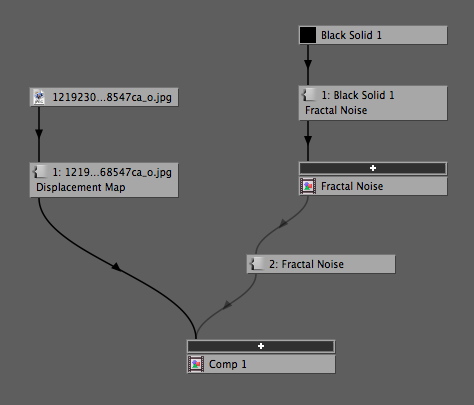
Nodal apps have a reputation for being "high end" and unapproachable, but I call bullshit on that. Take a simple example of displacing an image with some fractal noise. In a nodal system, this would be three nodes; a loader, a noise creator, and a displacement. Anyone, with any level of experience, would get this right on the first try in Fusion. But put the same problem to a new After Effects user, and watch them struggle. Once you start explain to them how, because of the internal order of operations, it is necessary to precomp the noise layer, you are asking them to imagine the nodal structure of their composite in their head.

After Effects users are visual people, but in this example After Effects has now eliminated any visual connection between the noise layer and the displacement effect. Sure, there are several places where you can see that "Noise Precomp" is used in "Comp 1," but the very fact that there are many places to check this is indication that there's no one good place like there is in Shake. One of the most important connections, between the Displacement Map effect (on Comp 1 layer 1) and the Fractal Noise layer (Comp 1 layer 2), isn't even shown!

Adobe, please give After Effects complete nodal capabilities. Look to Combustion and Toxik for inspiration. Both have layered comps, and both allow you to work without ever looking at the nodes if that's your choice. In other words, I'm not advocating changing anything (big) about how After Effects works—I am simply asking for the UI to show how After Effects works.

How To Make a Long Tail Movie

Chris Anderson, author of The Long Tail, posted some excerpts from The DV Rebel’s Guide on his blog.

I'm flattered to have the DV Rebel approach categorized as a long tail concept. It's great to have some confirmation from the man himself that democratization of production and distribution doesn't mean that everything we make and watch has to be webcam videos of kids lip-synching!

Update: The Cool Tools review that Anderson was quoting has been posted. Kevin Kelly really seems to "get" The Guide—he points out the stuff I knowingly skipped over because it's been done well in other books, and advocates The Guide's software-centric approach.